 MoraFlow
箸
Speak Japanese More Naturally.
Master Japanese pitch accent through interactive listening exercises, pronunciation practice, and personalized feedback. Develop the skills to speak Japanese more naturally and confidently.
16 listening questions, about 4 minutes. No account needed.
Same sounds, different words
あめ雨が
rain
Try it
Hear the pitch. See it move.
Japanese words rise and fall in pitch from one mora (one beat) to the next. Pick a word, play it, and follow the line. These are the same graphs and recordings you’ll practice with in MoraFlow.
箸, 橋 and 端 are all read はし. Only the pitch tells them apart.
Why pitch accent
The part of Japanese most courses skip.
You can know the vocabulary, the grammar and the right sentence, and still sound off. Pitch accent is a big part of why. MoraFlow is built around it.
Hear the Difference
Train your ears to recognize the subtle pitch patterns that distinguish natural Japanese pronunciation.
Master Pitch Accent
Understand the four fundamental Japanese pitch accent patterns and learn how they apply to real vocabulary.
Speak with Confidence
Develop more natural pronunciation and improve your confidence when communicating in Japanese.
はし↘が橋 bridgeはしが端 edge
Some words, the 尾高型 (odaka) pattern, only show their accent on the particle that follows. On its own, 橋 (bridge) sounds just like 端 (edge). That’s why MoraFlow plays words with their particle (が, or な for na-adjectives), so you can hear whether the pitch drops after the word or stays high.
Inside MoraFlow
Hear it, see it, say it.
Listening, seeing and speaking, in one place. Every screen below is from the app as it is today.
Daily Training
Twenty questions a day, at your level.
One session a day keeps practice steady. Your placement test sets where you start, and your level moves up as you improve.
- Starts with minimal-pair pitch perception training if you need it
- New words always start at N5 and work up to N1, whatever your level, so you learn the pitch of words you already know
- Already know a word? Answer its pitch right, then one click fast-tracks it to mastered so you don’t keep reviewing it
- Spaced repetition brings back the words you missed
Listening and pitch perception
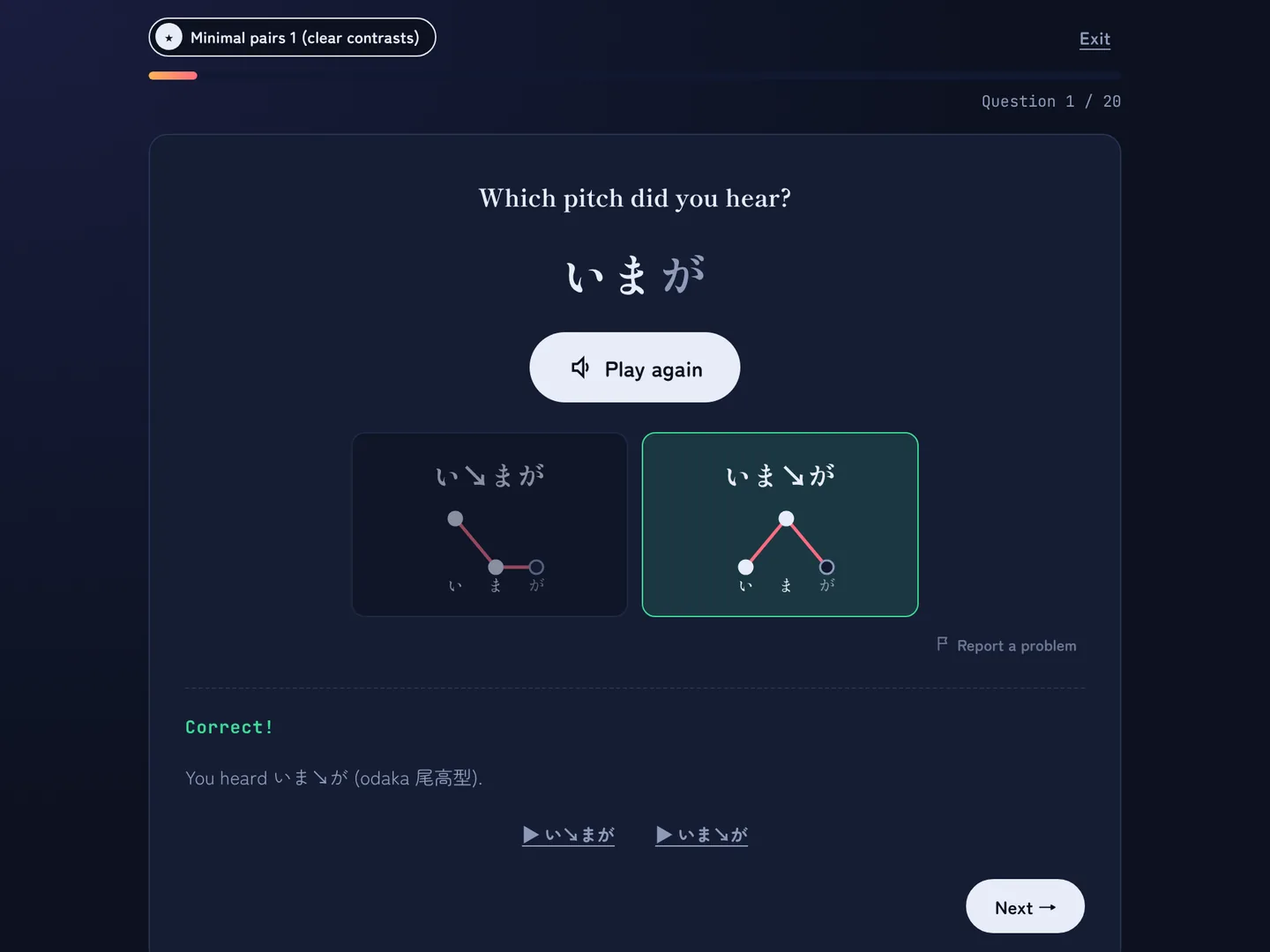
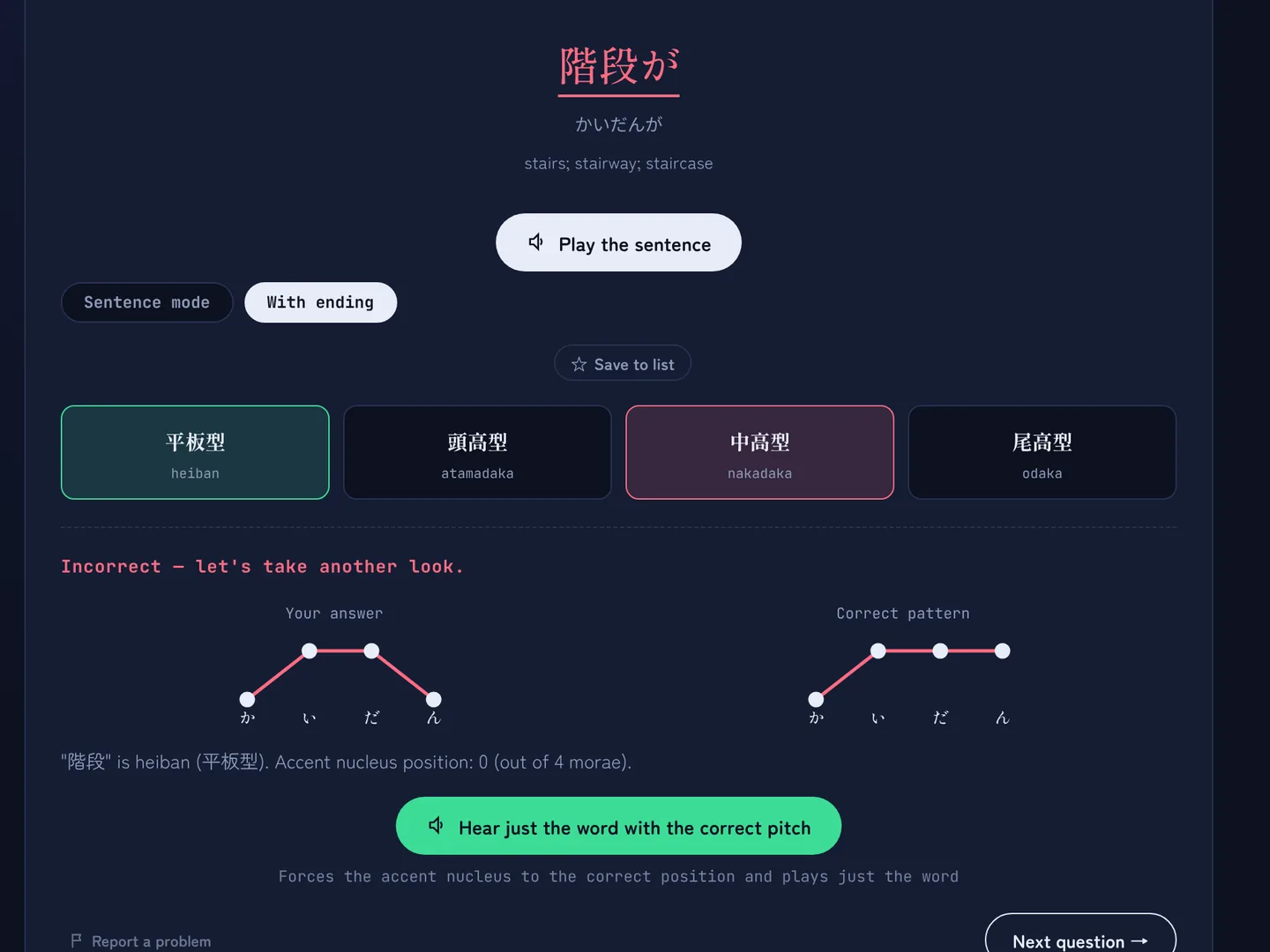
Hear the difference pitch makes.
Every word is played with its checked accent and the particle that follows. Choose the pattern you hear, then see your answer and the correct pitch graph side by side.
- Listening quiz by JLPT level, in words or full sentences
- Pitch perception training with minimal pairs: はし↘が, は↘しが or はしが?
- Memory quiz: recall a word’s pitch with no audio
Pronunciation practice
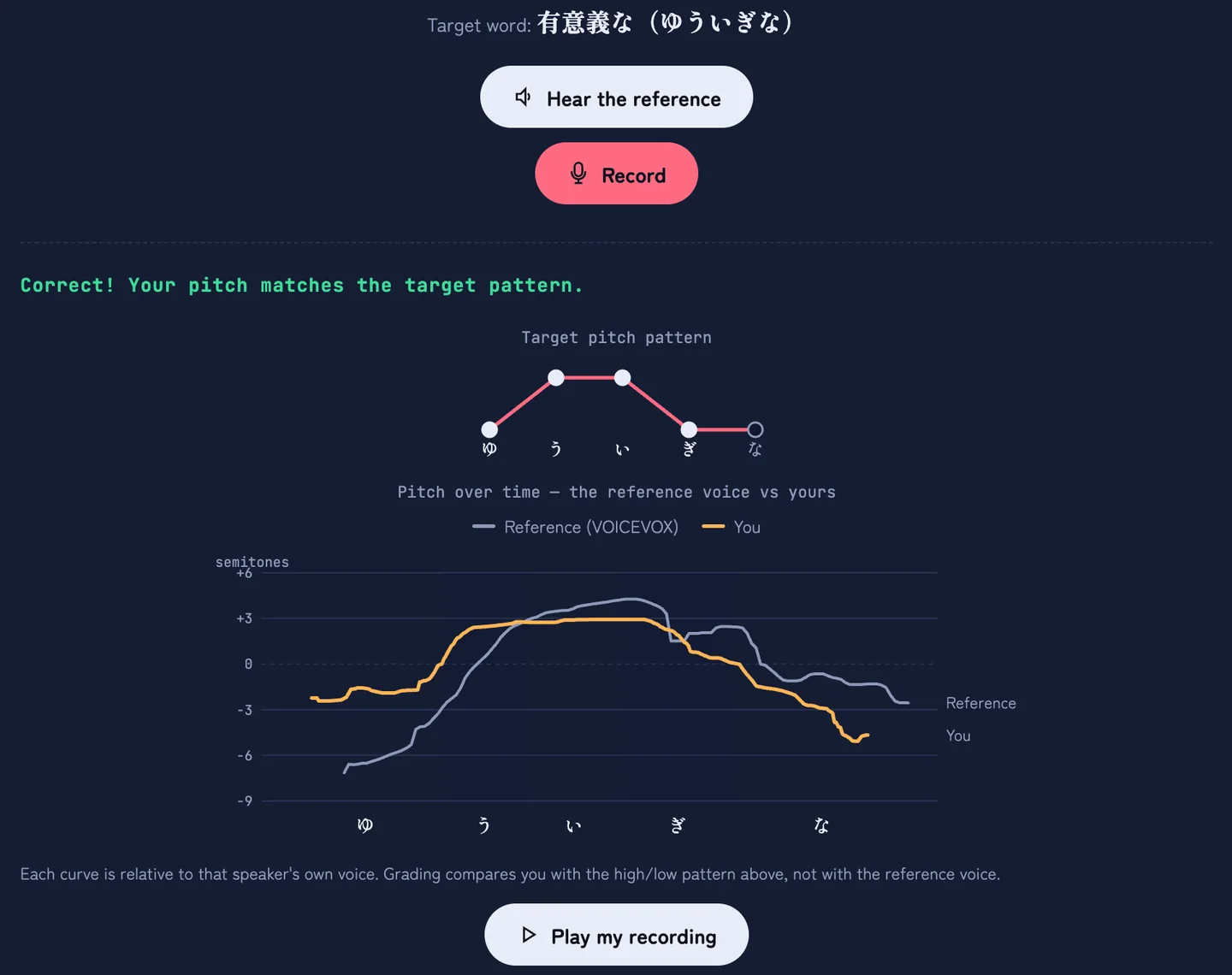
Say it, then see your own pitch.
Record a word and MoraFlow tracks the pitch of your voice, in semitones, and draws it over the reference voice mora by mora. It grades where your pitch drops in your own voice, so you don’t have to imitate the reference speaker.
- Your pitch curve and the reference, side by side
- Words practiced with their particle, like in real speech
- Sentence practice for longer phrases
Sentence pitch training
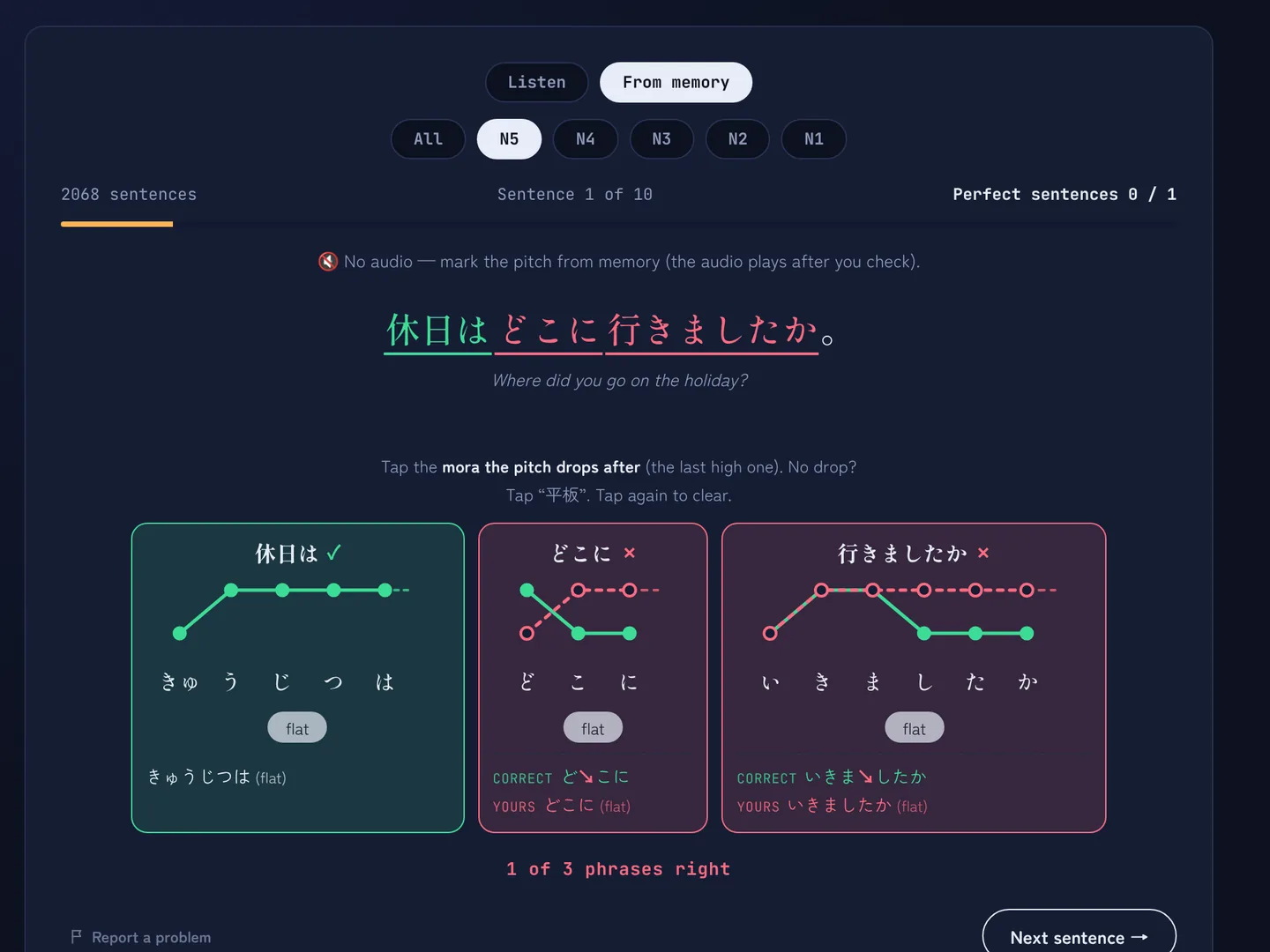
Pitch doesn’t stop at the word.
Mark the high and low pitch across a whole sentence, then check it against the answer key. Listen first, or try it from memory.
Structured learning modules
Learn how pitch accent works, step by step.
Short lessons with audio, graphs and quick checks: what pitch accent is, how morae work, the four patterns, and what happens to particles.

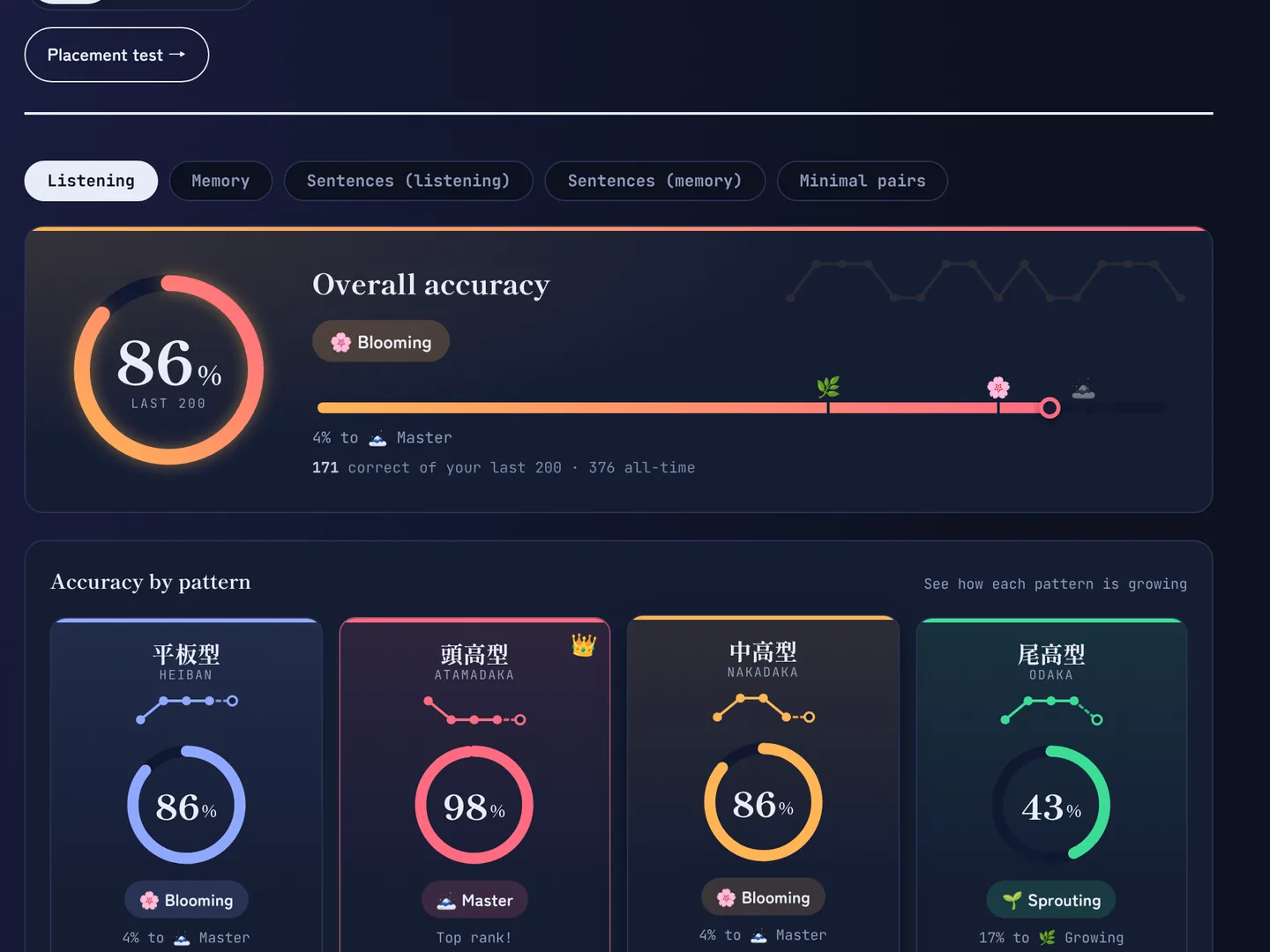
Progress tracking and statistics
See which patterns still trip you up.
Accuracy for each pattern, your trend over time, a daily streak and XP. You’ll know exactly what to practice next.
Word lookup and reference
Search any word to see its accent as a pitch graph and hear it. Place names, counters and surnames have their own pages.
Word lists and Anki
Save the words you’re studying and practice just those. Import your Anki decks, or export your lists to Anki with audio.
Sentence analyzer Coming soon
Paste any Japanese sentence and see its pitch accent, phrase by phrase.
The data behind it
A pitch accent dictionary you can trust.
MoraFlow starts from the open Kanjium accent data, then checks and corrects it against the NHK Japanese pitch accent dictionary, OJAD and native speakers. Words with more than one accepted accent keep all of them, with the more standard modern one shown first.
- Words with pitch accent in the dictionary
- 112,000+
- Example sentences, with English translations
- 19,000+
- Study words from JLPT N5 to N1
- 8,400+
- Recorded audio clips per voice
- 34,000+
- Word entries corrected from Kanjium after checking NHK, OJAD and native speakers
- 220+
- Sentence recordings audited and pitch-corrected
- 4,600+
- Words with more than one accepted accent
- 930
- Minimal-pair sets, plus 130 onomatopoeia
- 285
- Place names, counters and surnames with their own accents
- 830+
How it works
Three steps to more natural Japanese.
-
Discover Your Level
Take a short placement test to understand your current ability to recognize Japanese pitch accent.
-
Sharpen Your Pitch Perception
Practice listening, identifying pitch patterns, and understanding how pitch accent works.
-
Improve Your Pronunciation
Build consistent practice habits and develop more natural Japanese pronunciation over time.
Take the Free Placement Test
No account needed to start.
About the founder
About the founder
Knowing Japanese is one thing. Feeling confident speaking it is another.
Mason Young, founder of MoraFlow
Built by a Japanese learner, for Japanese learners.
I’m an American who has spent years learning Japanese and living and working in Japan. Along the way, I discovered just how much the way you speak can shape your experience with a language.
My Japanese, particularly my pitch accent, has helped me build meaningful relationships in Japan. I also believe it played an important role in helping me land my first job here, at a time when Japanese was essentially my only real skill.
Good pitch accent is still relatively rare among Japanese learners. Developing it can be one of the clearest ways to make your Japanese sound more natural, stand out as a speaker, and become easier to understand.
While I still have a long way to go on my Japanese learning journey, as my Japanese began to sound more natural, I became more comfortable speaking up in conversations, participating in meetings, and using Japanese in everyday life. I stopped worrying quite so much about how I sounded and started focusing more on what I wanted to say.
That’s why I built MoraFlow.
Most language-learning tools focus on helping you understand Japanese. MoraFlow focuses on helping you sound natural and feel confident using the Japanese you already know.
Read Mason’s storyReady to Speak More Naturally?
Find out where you stand and start improving your Japanese pitch accent today.